
Inco's DFlash 2 drafter drafts a whole block in one pass for Qwen3.8-27B. The weights are open. You download a target and a matching drafter, then run them on your own GPU. On a 32 GB RTX 5090 the cited path is NVFP4 weights plus the BF16 draft. On one DGX Spark the cited memory pin is 0.80. An independent SGLang grid on a 5090 reports spec-decode time per output token of 4.92 ms, against 14.40 ms with speculative decoding off.7
This lab ran the work on a 32 GB RTX 5090 and a NVIDIA DGX Spark.
What's new
DFlash 2 shipped on 18 August 2026 from Inco AI (z-lab / UC San Diego). The launch post is "DFlash 2: Keep Drafting Parallel."1 There is no separate DFlash 2 paper on arXiv. The authors cite that blog, plus the earlier DFlash paper.
This Hugging Face repo is a drafter. It is not a chat model. The card says it runs inside a speculative-decoding server and proposes tokens for a named target to verify.2
The config architecture is DFlash2DraftModel. The checkpoint is BF16 safetensors. is_causal is false. The author non-GGUF repos do not ship FP8, NVFP4, or GGUF files. Community quants exist outside those repos.
The prior method is DFlash, arXiv:2602.06036, presented at ICML 2026. That paper is one-pass block diffusion, with a project-page block size of 16 and one denoising step. Its "over 6x" claim, and the "up to 6.1x on Qwen3-8B" figure, belong to DFlash. They are not DFlash 2 results.3
DFlash 2 keeps the one-pass block. It adds two modules. A path selector keeps the top 16 candidates and scores adjacent pairs with a rank-256 match. A two-tap grouped dynamic convolution, kernel 2 and group 16, sits before and after each attention block and each feed-forward block.
On the authors' Qwen3.5-4B run, mean accepted tokens move from 4.92 with DFlash to 5.97 with DFlash 2. That is 1.05 more tokens, about 21 percent, for 1.3 percent more cycle latency.1 On Qwen3.8-27B, block size 8, mean accept length is 4.80 for DFlash 2, 4.28 for the built-in MTP head, and 3.62 for DSpark.2
The 4.92 in that Qwen3.5-4B sentence is an acceptance length. Later in this piece, 4.92 ms is a 5090 time-per-token. Same digits. Different unit. Different machine.
Canonical weights live at incoai/Qwen3.8-27B-DFlash2. The Hub API sha is 015e795645c74b1a0eeef3b570031fb62e769bc5. The repo was created on 18 August 2026. The download counter on 9 November 2026 read 437,556.2 The mirror z-lab/Qwen3.8-27B-DFlash2 stores the same model.safetensors object, LFS oid 67fc76d68dc5a9415511a4f394ef744d67510cd20e93b37cc2cc7d28e4bab65c, 3,848,817,896 bytes, about 3.85 GB, 1,924,404,480 parameters.
The collection incoai/dflash-2 holds 11 models. There is no author repo whose id is literally DFlash2 or DFlash-2.4
Launch day covered two drafters: Qwen3.8-27B and Muse-Glimmer-30B. Later first-party drafters exist for Qwen3.8-Flash-Next, Qwen3.6-35B-A3B, GLM-5.3, GLM-5.3-Flash, Flint, Ornith-1.5-122B, and MiniMax-M3.1-Flash. This guide stays on Qwen3.8-27B. That is the pair the 5090 and Spark cookbook actually pins.
Author speed tables for this Qwen drafter were measured on one H200. Later model cards use a GB300. Neither table is a 5090. Neither table is a Spark.
Lossless, on the card, means greedy text matches the target, and sampling keeps the target's distribution, when the drafter was built for that target. A mismatched fine-tune can accept nothing. vLLM issue 61072 records a pairing whose acceptance hit 0 percent.15 Load the drafter next to the target named on its card.
Supported targets
Each line is one drafter, one target, and the draft-token integer the authors printed. SGLang's integer and vLLM's integer differ on purpose. Block size 8 is 7 draft tokens per verify step on the Qwen card. vLLM's num_speculative_tokens must be block size minus 1. Leave both integers as printed.
incoai/Qwen3.8-27B-DFlash2drafts forQwen/Qwen3.8-27B. Block size 8. Target layers 5, 19, 33, 47, and 61. SGLang--speculative-num-draft-tokensis 8. vLLMnum_speculative_tokensis 7. The GGUF example target isggml-org/Qwen3.8-27B-GGUF:Q4_K_M, with--spec-draft-n-max7.2incoai/Qwen3.8-Flash-Next-DFlash2drafts forQwen/Qwen3.8-Flash-Next(the card's eval is FP8). Block size 8. The card serves 4 draft tokens because of Qwen sparse attention. The BF16 file is about 1.21 GB. Apache-2.0.incoai/Muse-Glimmer-30B-DFlash2drafts formeta-models/Muse-Glimmer-30B. Block size 16. SGLang uses 16. vLLM uses 15. About 5.54 GB BF16. It is a finetune of Meta's official DFlash drafter. Apache-2.0.incoai/Qwen3.6-35B-A3B-DFlash2drafts forQwen/Qwen3.6-35B-A3B. Block size 8. Apache-2.0.incoai/GLM-5.3-DFlash2drafts forzai-org/GLM-5.3. Block size 8. License is CC BY-NC-ND 4.0.incoai/GLM-5.3-Flash-DFlash2drafts forzai-org/GLM-5.3-Flash. Block size 8. About 1 billion parameters. The card says benches are being re-measured. License is CC BY-NC-ND 4.0. No author GGUF.13incoai/Flint-DFlash2drafts forRecursiveSI/flint. Apache-2.0. It is outside the 11-item collection.incoai/Ornith-1.5-122B-DFlash2drafts forornith-ai/Ornith-1.5-122B. Block size 16. Apache-2.0. An extramask_embedding.safetensorsis 6,432 bytes. Inco's eval is two GB300 GPUs at tensor parallel 2. That eval is not a Spark result.incoai/MiniMax-M3.1-Flash-DFlash2drafts forMiniMaxAI/MiniMax-M3.1-Flash. Block size 8. Apache-2.0.
Licensing
The Qwen3.8-27B drafter is Apache-2.0 and ungated. The same Apache-2.0 tag is on the Qwen, Muse, Flint, Ornith, MiniMax, and Qwen3.6 drafters, including the official GGUFs.2
incoai/GLM-5.3-DFlash2 and incoai/GLM-5.3-Flash-DFlash2 are CC BY-NC-ND 4.0. That license is research and evaluation. Commercial terms go through contact@inco.ai.1317 The two-Spark GLM recipe later in this piece sits under that license. The Qwen drafter does not.
The z-lab/dflash code repository is MIT. That is a code license. It does not relicense the GLM weights.16
For llama.cpp text, prefer the z-lab GGUF mirror. A llama.cpp collaborator, ngxson, reported that many incoai GGUFs were broken. The blog's llama.cpp tab still points -hfd at incoai. GGUFs built before 27 August 2026 break vision. Even on a later file, image acceptance can fall below 0.03. This guide covers text. It does not promise vision.10
Performance
Every figure below is speculative decoding. The label on each block names the GPU, the engine, and whether the source is the author or an independent run. A spec-decode speed is not a stock GGUF decode speed.
Author, one H200, SGLang, FlashAttention 3, block size 8, concurrency 1. Throughput is output tokens per second against autoregressive decoding at about 69. This is not a 5090. This is not a Spark.2
- GSM8K: autoregressive 68.9, DFlash 2 236.1 (3.43x).
- MATH-500: 69.0 and 230.7 (3.34x).
- HumanEval: 69.0 and 214.6 (3.11x).
- MBPP: 69.0 and 226.9 (3.29x).
- MT-Bench: 68.9 and 184.0 (2.67x).
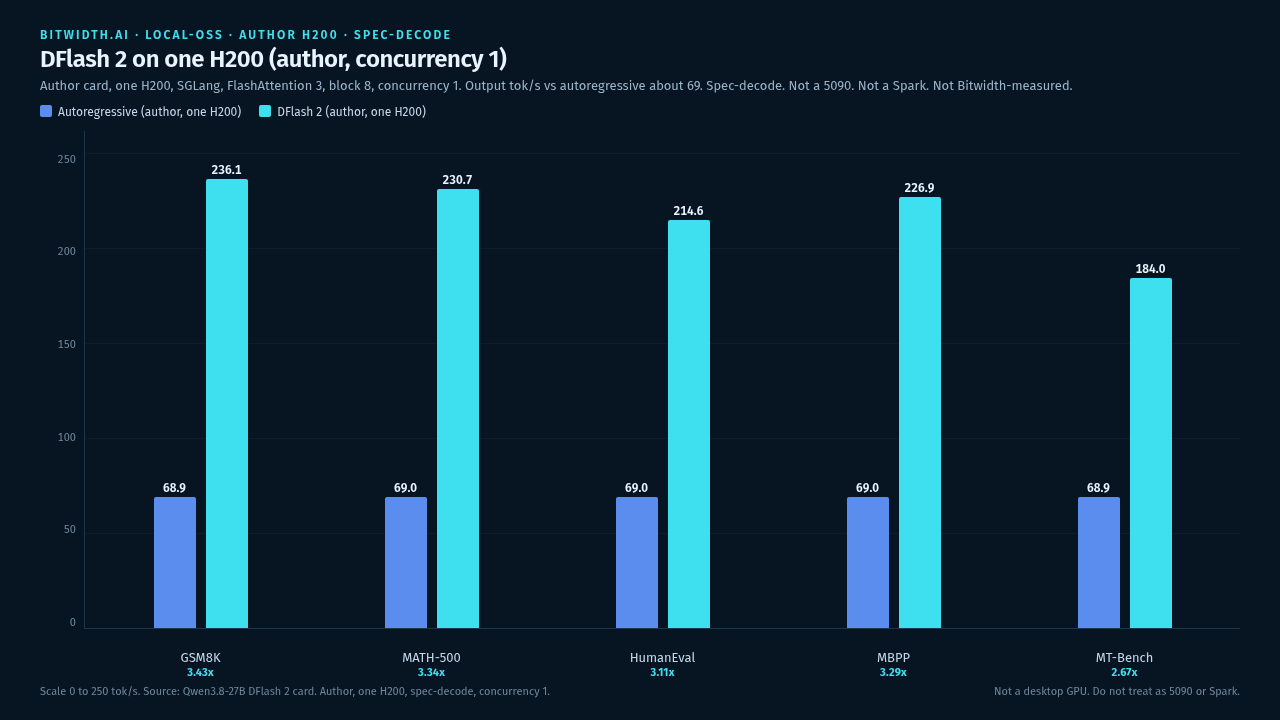
Author, one H200, SGLang, spec-decode, concurrency 1. The bars are those five tasks. This is not a desktop GPU.
On that same model card, concurrency 32 cuts DFlash 2 to 1.01x through 1.45x. MTP and DSpark drop under 1x on some tasks. A batch-1 speedup is the wrong number for a busy server.
Acceptance length on that model card is completion tokens divided by verification steps. GSM8K 5.46. MATH-500 5.28. HumanEval 4.39. MBPP 4.79. MT-Bench 4.10. The means across methods are MTP 4.28, DSpark 3.62, DFlash 2 4.80.
Independent, RTX 5090, SGLang pull request 35825. Image lmsysorg/sglang:dev-qwen38-27b-dflash2, commit 1cf2b8c. Workload is 8192 input tokens and 1024 output tokens, concurrency 1. The published figure is time per output token, in milliseconds. The pull request does not convert that into tokens per second. This guide does not either.7
- DFlash 2 bf16, memory fraction 0.91, chunk 1024: 4.92 ms, accept length 4.29.
- Speculative decoding off, bf16, same box: 14.40 ms.
- EAGLE bf16: 8.07 ms, accept length 3.02.
- DSpark bf16: 7.41 ms, accept length 2.59.
- DFlash 2 float32 on that 5090: greyed out. Memory fraction 0.86 through 0.96 never reached the slot count.
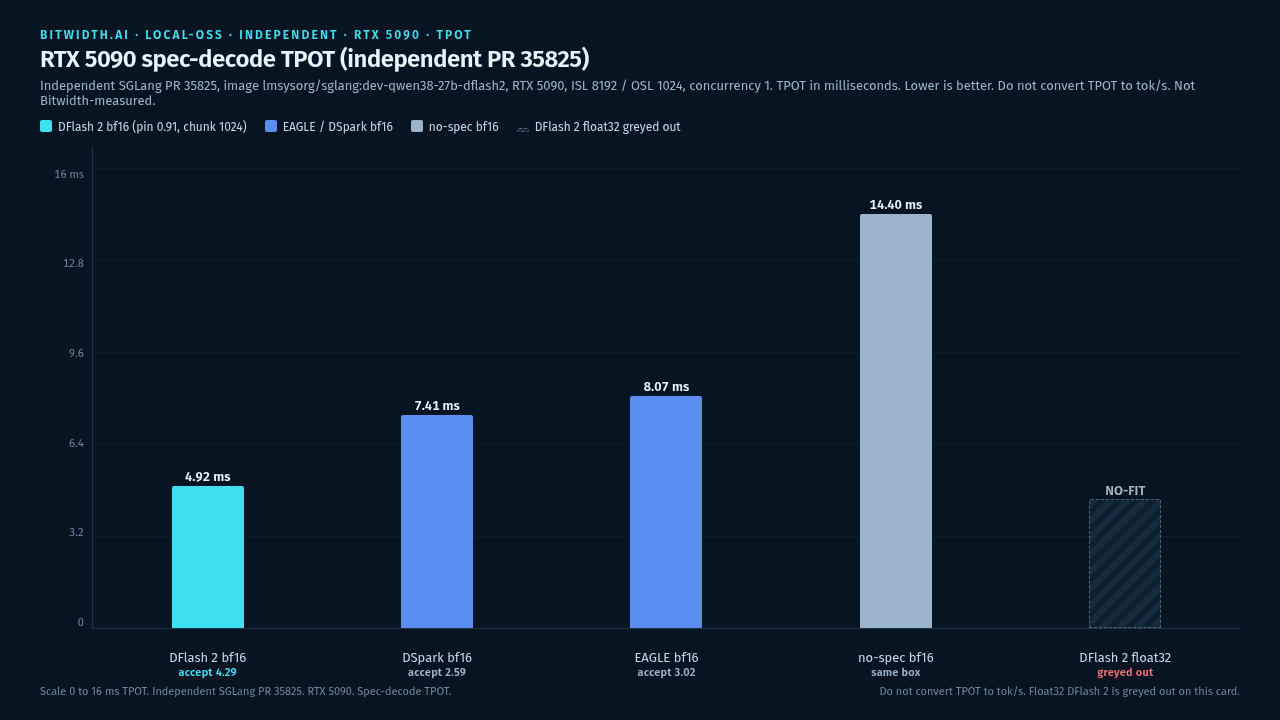
Independent SGLang pull request 35825, RTX 5090. The figure is spec-decode time per output token. Float32 is greyed out.
Independent, RTX PRO 6000, same pull request, different GPU. Pin 0.85 and chunk 2048. BF16 plus DFlash 2, low latency, float32: 8.19 ms, accept length 5.42. NVFP4 with a BF16 language-model head plus DFlash 2, low latency, float32: 5.36 ms, accept length 4.19. That GPU is 96 GB. It is not the 5090 pin.
Independent, one RTX 3090, 24 GB, llama.cpp, one user on the official discussion. Target Q4, DFlash 2 Q8 draft, context 163840, n_max 4, about 23.08 GB resident. Sustained generation is 59.88 tokens per second, spec-decode. The same post's Q4 run with speculative decoding off is 33.16 tokens per second at 128K. The contexts differ, so the ratio is the poster's arithmetic, not a matched pair. On that thread, n_max 8 clamped to 7 and then ran out of GPU memory near 176K context.12
A second 3090 note, from @treo on the llama.cpp pull request, used a Q4 draft, context 32000, and n_max 4. Spec-decode speed was 62.21 tokens per second. MTP on that note, at n_max 3, was 57.79. They used 4 because 7 was slower.10
Independent, two DGX Sparks, GLM-5.3-Flash, not Qwen3.8-27B. A forum SGLang run at tensor parallel 2 reports code at 29.4 tokens per second and prose at 23.4, against 14.7 with speculative decoding off.19 A separate vLLM overlay, warm concurrency 1, reports code at 46.9 tokens per second against MTP-4 at 21.8.14 The drafter license is CC BY-NC-ND 4.0.13 These two posts stay separate. Neither one is a Qwen3.8-27B speed.
Bitwidth lab, 9 November 2026
The H200 rows, the SGLang time-per-token cells, the 3090 notes, and the two-Spark GLM notes above are other people's measurements. This block is Bitwidth's own lab on 9 November 2026.
The RTX 5090 server is LM Studio, GGUF Q4_K_M, model id qwen/qwen3.8-27b. The bench JSON does not record draft method or draft width. Wes described the server as MTP with 3 draft tokens. This run is not DFlash 2. It is not the 4.92 ms cell.
The DGX Spark server is vLLM on one GB10. BF16 Qwen/Qwen3.8-27B plus incoai/Qwen3.8-27B-DFlash2 at 7 draft tokens for the 15:30 benches. FP8 Qwen/Qwen3.8-27B-FP8 plus the same drafter at 3 draft tokens for the 16:42 arena. The measured container was ghcr.io/spark-arena/dgx-vllm-eugr-nightly, a vLLM nightly, not vllm/vllm-openai:latest. The engines and the quants do not match the 5090 run, so this is not a same-checkpoint speedup.
Perf is a short prompt, concurrency 1, 2, and 4, three requests, 128 max tokens. Arena is concurrency 1, 2, 5, and 10, three requests, about 2048 prompt tokens and 128 generated tokens. Both sample at temperature 0.7. Aggregate tok/s is output tokens divided by wall clock. It rises with concurrency. It is not one stream's decode speed. Every level finished with 3 ok requests and 0 errors. No FP8 perf run was stored.
5090 LM Studio perf, 14:35, id 0a9a9a22cf44:
- Concurrency 1: 54.9 aggregate tok/s, per-request p50 76.8, TTFT p50 536.6 ms, wall 6.99 s.
- Concurrency 2: 81.2 aggregate tok/s, per-request p50 73.5, TTFT p50 318.1 ms, wall 4.73 s.
- Concurrency 4: 126.2 aggregate tok/s, per-request p50 55.4, TTFT p50 358.1 ms, wall 3.04 s.
Spark vLLM, BF16, DFlash 2, 7 draft tokens, perf, 15:30, id bfbbb73c2e73:
- Concurrency 1: 11.0 aggregate tok/s, per-request p50 12.4, TTFT p50 859.2 ms, wall 27.87 s.
- Concurrency 2: 15.7 aggregate tok/s, per-request p50 12.1, TTFT p50 878.3 ms, wall 17.67 s.
- Concurrency 4: 26.1 aggregate tok/s, per-request p50 11.1, TTFT p50 1237.5 ms, wall 10.49 s.
5090 LM Studio arena, 14:35, id f0bdbb9a3b8c:
- Concurrency 1: 72.0 aggregate tok/s, per-request p50 114.6, prefill p50 15810.4, TTFT p50 123.4 ms, wall 5.33 s.
- Concurrency 2: 113.0 aggregate tok/s, per-request p50 102.2, prefill p50 13817.3, TTFT p50 141.2 ms, wall 3.40 s.
- Concurrency 5: 146.2 aggregate tok/s, per-request p50 74.4, prefill p50 3315.2, TTFT p50 588.5 ms, wall 2.63 s.
- Concurrency 10: 161.0 aggregate tok/s, per-request p50 107.0, prefill p50 2536.4, TTFT p50 769.2 ms, wall 2.39 s.
Spark vLLM, BF16, DFlash 2, 7 draft tokens, arena, 15:31, id f8ebddfb128e:
- Concurrency 1: 12.8 aggregate tok/s, per-request p50 13.5, prefill p50 2044.2, TTFT p50 967.6 ms, wall 30.11 s.
- Concurrency 2: 18.5 aggregate tok/s, per-request p50 12.9, prefill p50 1998.2, TTFT p50 989.9 ms, wall 20.75 s.
- Concurrency 5: 27.6 aggregate tok/s, per-request p50 12.4, prefill p50 1168.7, TTFT p50 1692.5 ms, wall 13.92 s.
- Concurrency 10: 26.5 aggregate tok/s, per-request p50 10.8, prefill p50 1172.1, TTFT p50 1687.5 ms, wall 14.51 s.
Spark vLLM, FP8, DFlash 2, 3 draft tokens, arena, 16:42, id ed88999295b3:
- Concurrency 1: 18.2 aggregate tok/s, per-request p50 19.7, prefill p50 5128.3, TTFT p50 385.7 ms, wall 21.07 s.
- Concurrency 2: 27.3 aggregate tok/s, per-request p50 19.0, prefill p50 3602.3, TTFT p50 549.1 ms, wall 14.06 s.
- Concurrency 5: 43.5 aggregate tok/s, per-request p50 17.3, prefill p50 2512.4, TTFT p50 787.3 ms, wall 8.82 s.
- Concurrency 10: 42.1 aggregate tok/s, per-request p50 17.4, prefill p50 3102.7, TTFT p50 637.5 ms, wall 9.13 s.
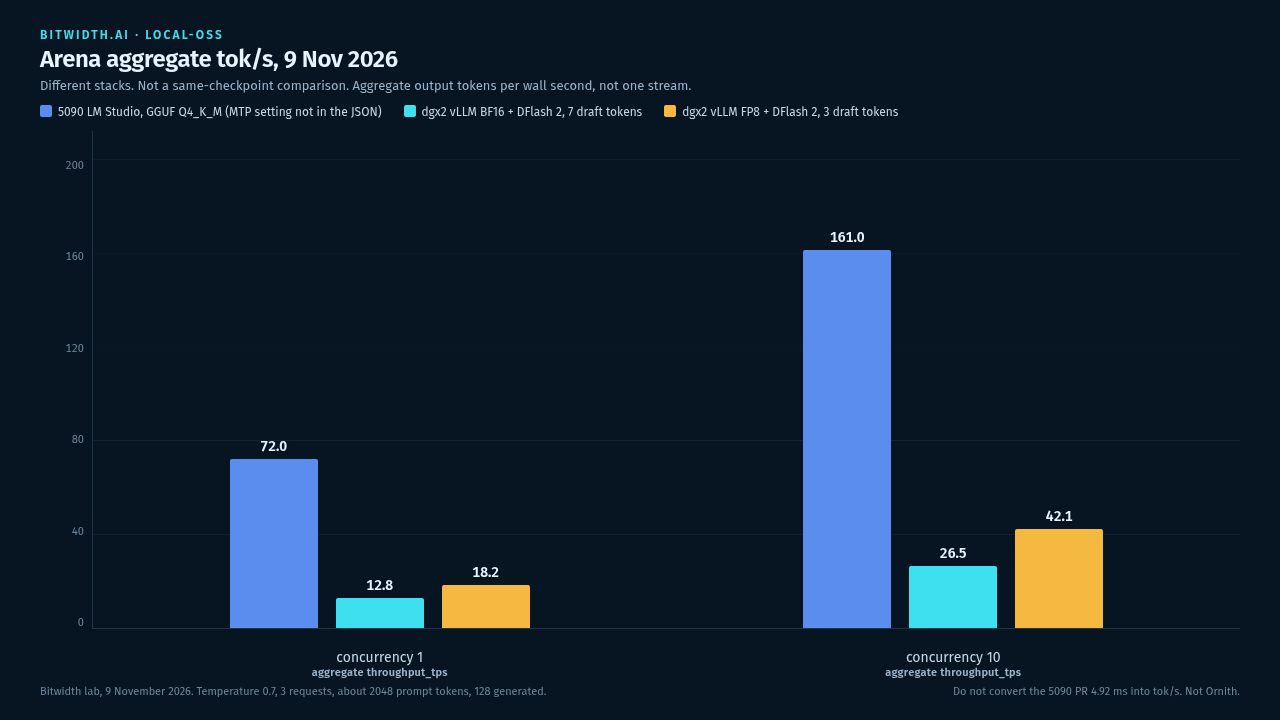
Arena aggregate tokens per second on 9 November 2026. The 5090 series is LM Studio. The Spark series are vLLM with DFlash 2. The stacks differ.
FP8 at 3 draft tokens is faster than BF16 at 7 draft tokens on this harness, and still far below the 5090 LM Studio server. A times-faster slogan would pretend the weights match.
Same-day operator smokes, temperature 0, a count-to-forty prompt, are not in the lists above: BF16 at 7 draft tokens was about 24.7 tok/s wall, BF16 at 3 draft tokens was 15.8 tok/s decode (249 of 252 draft tokens accepted), and FP8 at 3 draft tokens was 25.9 tok/s decode.
As of 9 November 2026, pull request 35825 and the Qwen3.8-27B cookbook publish no tokens-per-second figure for Qwen3.8-27B plus DFlash 2 on one DGX Spark. The checkpoints fit. Public sources still show no tok/s. The lists above are this lab's measurements.78
Older DFlash demos, and community overlays on custom vLLM images, are a different checkpoint or a different container. They are not the author H200 table. They are not the 5090 time-per-token cells above.
Local setup
Download the target and the drafter before you pick an engine. For the Qwen pair the target is Qwen/Qwen3.8-27B, or an NVFP4 export on a 32 GB 5090. The drafter is incoai/Qwen3.8-27B-DFlash2. For llama.cpp, use z-lab/Qwen3.8-27B-DFlash2-GGUF.
Three paths are documented. vLLM has a current Docker image that accepts method dflash. llama.cpp has a GGUF server command. The measured 5090 and Spark grid used an SGLang image, and that image is not vllm/vllm-openai:latest.
vLLM
The floor is vLLM v0.28.0, tagged 26 August 2026, which contains pull request 52816.5 The model card still shows a pip install of that pull-request head. That pin is older than the release. Method dflash is a documented speculative-decoding method.18
Docker Hub tag vllm/vllm-openai:latest, read on 9 November 2026, has manifest digest sha256:d825baf9ce4b1b6bfc5ecc7b79880c7e6748c65a72d697ce3d47607aafa84c6e. It was pushed on 2 November 2026. It lists linux/amd64 and linux/arm64. CUDA 13 images want host driver R580 or newer.6
The block below is a BF16 assembly. The Docker skeleton is the official vLLM page. The speculative JSON is the Qwen card. It was not measured on a 5090. It was not measured on a Spark. BF16 Qwen/Qwen3.8-27B plus this drafter does not fit in 32 GB. The image entrypoint is already vllm serve, so the engine arguments follow the image tag.
Desktop, NVIDIA runtime:
docker run --runtime nvidia --gpus all \
    -v ~/.cache/huggingface:/root/.cache/huggingface \
    --env "HF_TOKEN=$HF_TOKEN" \
    -p 8000:8000 \
    --ipc=host \
    vllm/vllm-openai:latest \
    --model Qwen/Qwen3.8-27B \
    --speculative-config '{"method":"dflash","model":"incoai/Qwen3.8-27B-DFlash2","num_speculative_tokens":7}'
Spark, when the box is CDI-only. Same engine arguments. Still not a measured GB10 run:
docker run --device nvidia.com/gpu=all \
    -v ~/.cache/huggingface:/root/.cache/huggingface \
    --env "HF_TOKEN=$HF_TOKEN" \
    -p 8000:8000 \
    --ipc=host \
    vllm/vllm-openai:latest \
    --model Qwen/Qwen3.8-27B \
    --speculative-config '{"method":"dflash","model":"incoai/Qwen3.8-27B-DFlash2","num_speculative_tokens":7}'
Leave tensor parallel off both commands. Leave enforce_eager out of the JSON. vLLM 0.31 enables async scheduling for DFlash.20 The same notes capture the draft pass in a CUDA graph. A dedicated tag such as v0.28.0 is an extra image. It does not replace :latest in this section.
When that server is up, port 8000 speaks the OpenAI API. The models list is the first check:
curl http://127.0.0.1:8000/v1/modelsThat curl is the standard OpenAI models route on the port the Docker page publishes. It is not a benchmark.
LM Studio / llama.cpp
The LM Studio speculative-decoding page, fetched 9 November 2026, describes a smaller draft model that shares the target vocabulary. It does not name DFlash, DFlash 2, draft-dflash, or a GGUF drafter repo.11 A community post says LM Studio 0.4.22, with llama.cpp runtime 2.29.1 or newer, added DFlash assistant models. Confirm the picker in the app you have. This guide does not invent a menu path.
The documented local path is llama-server. Build a tree that contains llama.cpp pull request 27342, merged on 27 August 2026. The first tagged master build named for that flag is b10658.10 An older build fails a DFlash 2 GGUF with the wrong tensor count.
The serve command below follows the GGUF card, with -hfd pointed at the z-lab mirror. The card itself prints incoai in that slot. Prefer z-lab for text.9
./build/bin/llama-server \
  -hf ggml-org/Qwen3.8-27B-GGUF:Q4_K_M \
  -hfd z-lab/Qwen3.8-27B-DFlash2-GGUF:Q4_K_M \
  --spec-type draft-dflash \
  --spec-draft-n-max 7
Official GGUF sizes, same byte counts on the incoai repo and the z-lab mirror: Q4_K_M is 1,143,006,816 bytes (the card rounds to 1.1 GB). Q8_0 is 2,056,414,816 bytes (2.0 GB). BF16 is 3,860,293,216 bytes (3.8 GB).9
The card's own check, first eight GSM8K examples, reports acceptance length 5.28 at BF16, 5.13 at Q8_0, and 5.39 at Q4_K_M. That is acceptance length. It is not tokens per second.
The llama.cpp docs convert example is DFlash v1, model z-lab/Qwen3-4B-DFlash, with --spec-draft-n-max 15. Leave 15 on that older draft. The 27B GGUF card already ships converted files.
On one 3090 at long context, n_max 4 beat n_max 7. Keep 7 next to the card command. Keep 4 next to that thread. The flags that user printed, with their own file paths:12
-m /models/Qwen3.8-27B-UD-Q4_K_XL.gguf
--model-draft /models/Qwen3.8-27B-DFlash2-Q8_0.gguf
--n-gpu-layers all
--n-gpu-layers-draft all
--threads 20
--cache-type-k q4_0
--cache-type-v q4_0
--flash-attn on
--ctx-size 163840
--parallel 1
--reasoning off
--spec-type draft-dflash
--spec-draft-n-max 4
--jinja
One DGX Spark
One Spark is a GB10, SM121, with 128 GB of unified memory. The Qwen3.8-27B cookbook says the BF16, FP8, and NVFP4 checkpoints fit in that pool.8
The measured DFlash 2 cells serve at --mem-fraction-static 0.80. At 0.85, DGX OS earlyoom sent SIGTERM to 15 of 48 cells, exit -15, with about 8 GB left for the OS.7 Attention on SM121 is flashinfer. trtllm_mha is SM100 only.
The image next to "it served" is lmsysorg/sglang:dev-qwen38-27b-dflash2, from pull request 35825, commit 1cf2b8c. A generic lmsysorg/sglang:latest pull is a different tag.
docker pull lmsysorg/sglang:dev-qwen38-27b-dflash2The card's H200 quick start is a host launcher, not the Spark pin. It is copied here so the flag names are the ones on the card:2
python -m sglang.launch_server \
  --model-path Qwen/Qwen3.8-27B \
  --speculative-algorithm DFLASH \
  --speculative-draft-model-path incoai/Qwen3.8-27B-DFlash2 \
  --speculative-num-draft-tokens 8
On one Spark, add the cookbook pins. The draft token count stays 8:
--attention-backend flashinfer \
--mem-fraction-static 0.80 \
--speculative-algorithm DFLASH \
--speculative-draft-model-path incoai/Qwen3.8-27B-DFlash2 \
--speculative-num-draft-tokens 8
The cookbook generator builds docker run --gpus all with --shm-size 32g and --ipc=host, then substitutes the panel flags. On a CDI-only Spark the device flag is --device nvidia.com/gpu=all. The DGX Spark user guide still shows --gpus=all for a CUDA sample. Use the flag that box accepts inside a container.
Pull request 35825 and the cookbook publish no tokens-per-second figure for Qwen3.8-27B plus DFlash 2 on one Spark. Bitwidth's 9 November lab, under Performance, measured that pair on a different vLLM image. The :latest block above is not that measurement.
Two DGX Sparks
The official Qwen3.8-27B cookbook runs this model on a single Spark GPU. It does not publish a Qwen tensor-parallel DFlash 2 recipe. Leave --tensor-parallel-size 2 off vllm/vllm-openai:latest for this target.8
A community recipe uses a different model and a different license. GLM-5.3-Flash NVFP4, drafter incoai/GLM-5.3-Flash-DFlash2, two Sparks, tensor parallel 2. The image in that fork predates the DFlash 2 merge, so the authors bind-mount an overlay. It is not vllm/vllm-openai:latest. The flags they add:14
-v /var/tmp/models/GLM-5.3-Flash-DFlash2:/models/dflash2-draft:ro
--speculative-config '{"method":"dflash","model":"/models/dflash2-draft","num_speculative_tokens":7}'
Warm concurrency-1 code on that page is 46.9 tokens per second, spec-decode, against MTP-4 at 21.8. Acceptance on that sample is 74.1 percent (420 of 567).14 The license on the drafter is CC BY-NC-ND 4.0.13 The forum SGLang numbers, 29.4 and 23.4, are the other two-Spark GLM cite. They are not a command for Qwen3.8-27B.
Desktop GPU (5090 and below)
RTX 5090 (32 GB, SM120). The working cited stack is SGLang. The BF16 vLLM assembly in the vLLM section does not fit this GPU.
NVFP4 target weights plus the BF16 drafter incoai/Qwen3.8-27B-DFlash2 are the fit. The cookbook disables DFlash 2 on a 5090 unless the quant id starts with nvfp4, because the draft only fits on top of the NVFP4 weights. BF16 Qwen/Qwen3.8-27B plus this drafter is the no-fit case.8
Pull request 35825 names RadixArk/Qwen3.8-27B-NVFP4 as the export that keeps a BF16 language-model head, about 1.7 GB extra. A packed head blocks the selector path.7 The published 5090 cell in that pull request is labeled DFlash 2 bf16. Its spec-decode time per output token is 4.92 ms, accept length 4.29, against 14.40 ms with speculative decoding off.
Pins for that 5090: flashinfer, memory fraction 0.91, chunked prefill 1024. A 2048-token chunk's activations do not fit at 0.91. Draft tokens stay at 8. The image for the published timing is lmsysorg/sglang:dev-qwen38-27b-dflash2.
docker pull lmsysorg/sglang:dev-qwen38-27b-dflash2Flags cited for the 5090 NVFP4 path. They are the cookbook pins plus the pull request's repo id. They are not one copied container line:
--model-path RadixArk/Qwen3.8-27B-NVFP4 \
--speculative-algorithm DFLASH \
--speculative-draft-model-path incoai/Qwen3.8-27B-DFlash2 \
--speculative-num-draft-tokens 8 \
--attention-backend flashinfer \
--mem-fraction-static 0.91 \
--chunked-prefill-size 1024
Float32 DFlash 2 on the BF16-head export is greyed out on this 5090.
RTX PRO 6000 (96 GB). Same pull request. Memory fraction 0.85 and chunk 2048. No 5090 pin. BF16 plus DFlash 2, low latency, float32: 8.19 ms, accept length 5.42. NVFP4 with a BF16 language-model head plus DFlash 2, low latency, float32: 5.36 ms, accept length 4.19. trtllm_mha is still the wrong backend. This GPU is SM120.
RTX 3090 (24 GB). llama.cpp fits. Q4 target, Q8 draft, context 163840, n_max 4, about 23.08 GB, 59.88 tokens per second spec-decode. The command fragment is in the llama.cpp section. n_max 7 was slower on that thread. n_max 8 clamped, then ran out of memory.12
16 GB. Treat the 27B pair as no-fit. The published desktop floor for SGLang DFlash 2 is a 32 GB card plus NVFP4 target weights.
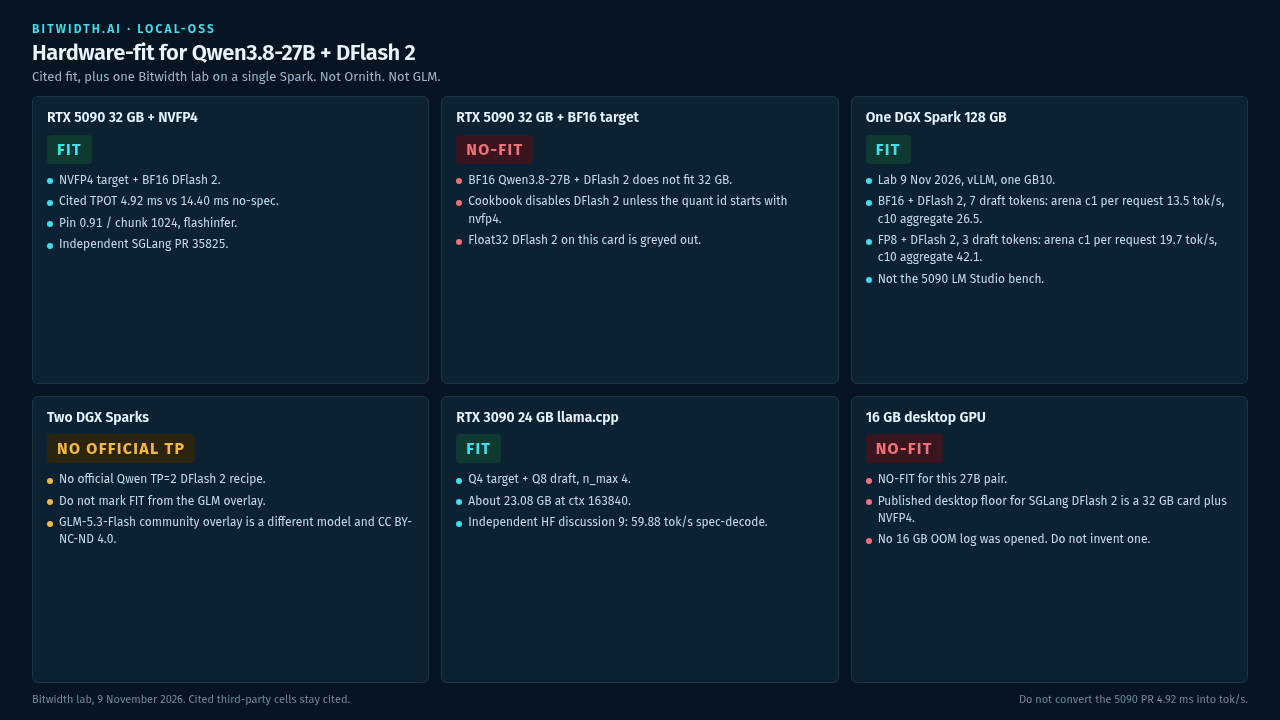
Hardware fit for Qwen3.8-27B plus DFlash 2. The two-Spark GLM overlay is a different model, so this chart does not mark two Sparks as a Qwen fit.


