
Large language models (LLMs) are the engines behind tools like ChatGPT, Claude, and Gemini. In plain terms, an LLM is a deep-learning model trained on enormous amounts of text so that it can understand and generate natural language and other content across a wide range of tasks. 1 This guide explains what they are, how they turn your words into an answer, and why they occasionally get things wrong — no math required.
The one-sentence version
An LLM is a very sophisticated next-word predictor. Given some text, it estimates the probability of every possible next piece of text and picks a likely one — then repeats. 3 Everything else is scale and refinement layered on top of that single idea.
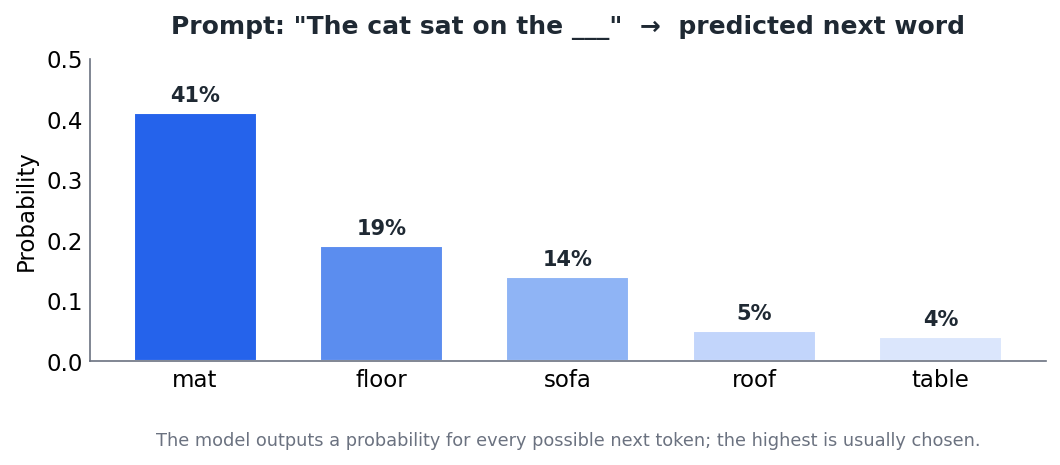
Figure 1 — For each step, the model produces a probability for every candidate next word.
What “large” and “language model” actually mean
A language model is any system that assigns probabilities to sequences of words. The “large” refers to two things: the vast text corpora these models train on, and the huge number of internal settings — called parameters — that they learn. 5 A parameter is simply a numerical value (a weight) the model adjusts during training to control how it processes input and makes predictions; modern LLMs can hold billions or even trillions of them. 4 More parameters and more data generally let a model capture more nuanced patterns.
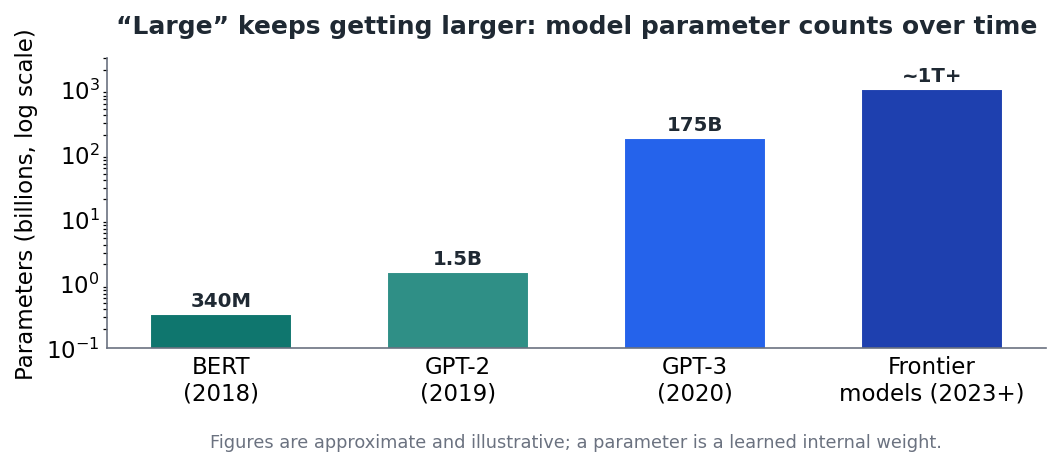
Figure 2 — “Large” has grown by orders of magnitude. Parameter counts are approximate and illustrative.
How they work: tokens, embeddings, and attention
When you send a prompt, the model does not read letters or words the way people do. It works in four broad stages:
- Tokenize. Your text is split into small pieces called tokens — whole words, parts of words, or punctuation.
- Embed. Each token is converted into a list of numbers (a vector) that captures aspects of its meaning and role.
- Process with a transformer. The numbers pass through a neural-network architecture called a transformer, introduced in 2017. Its key mechanism, self-attention, lets the model weigh how strongly every token relates to every other token, so it can use context efficiently. 2
- Predict the next token. The model outputs a probability for each possible next token, selects one, appends it to the text, and runs the loop again to produce the following token.
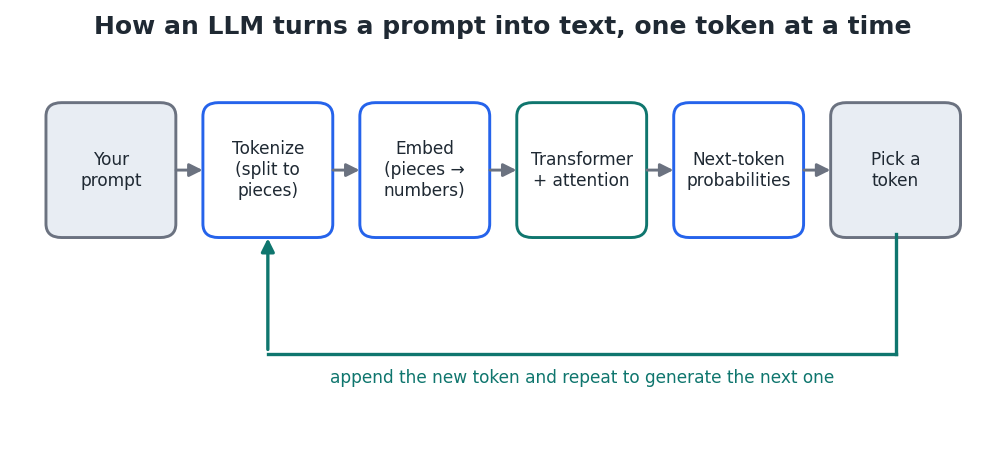
Figure 3 — Text is generated one token at a time; each new token feeds back in to produce the next.
Because attention compares all tokens in parallel rather than reading strictly left to right, transformers can be trained on very large datasets far more efficiently than the older approaches they replaced. 1
How an LLM learns
Training is mostly self-supervised: the text itself provides the answers. The model is shown a passage with the next token hidden, it guesses, and a loss function measures how far off the guess was. That error is used to nudge the parameters in a better direction, and the process repeats across millions of examples. 3 No human has to label the data, which is what makes training at internet scale possible. After this broad pretraining, models are usually fine-tuned on smaller, higher-quality datasets to specialize their behaviour, tone, and safety — for example, learning to follow instructions helpfully. 5
Why they seem smart — and why they still make mistakes
By predicting the next token across huge amounts of text, a model implicitly picks up grammar, facts, writing styles, and reasoning-like patterns. 3 That is why one system can draft an email, summarize a report, and explain code. But the same mechanism has limits. An LLM optimizes for text that is plausible, not text that is verified true. When it lacks the right information, it can produce confident but incorrect statements — commonly called hallucinations. It can also reflect biases present in its training data. 5 Treat outputs as a capable draft to check, not a source of guaranteed fact.
Key takeaways
- An LLM is a deep-learning model that predicts the most likely next token, over and over, to generate text. 1
- “Large” refers to the scale of training data and the billions–trillions of learned parameters. 4
- The transformer architecture and its self-attention mechanism are what make modern LLMs work.
- Training is self-supervised, then refined with fine-tuning.
- Outputs are optimized to be plausible, so always verify important facts.


